
Chesapeake Property Tax Record Fields
A Chesapeake property search for taxes crosses two offices. The Assessor sets the value. The Treasurer bills, collects, and tracks payments. Because each office answers a different question, a figure on an assessment notice is not the amount already paid or the balance still owed.
| Field | What It Shows | Where |
|---|---|---|
| Assessed value | Value used in the city's real-estate tax calculation. | Real Estate Assessor |
| Assessment date | Annual value date and effective date for the new roll. | Assessor notice and parcel record |
| Paid-tax status | Paid real-estate tax information for the tax year displayed. | Free paid-tax lookup |
| Outstanding balance | Delinquent real-estate tax and unpaid stormwater information. | Subscription information service |
| Supplemental bill | Quarterly billing related to new work or demolition. | Treasurer account |
Chesapeake's current rate for FY 2026–27 is $1.01 per $100 of assessed value. A $1.00 base rate makes up most of it. The remaining $0.01 funds mosquito control. The math is simple: divide assessed value by 100, then multiply by the rate. Exemptions can change what a taxpayer owes. The city publishes no complete exemption field list. Ask the Assessor for a parcel-specific answer.
Keep five dates straight: the tax year, the annual assessment date, the effective date, the bill event, and the payment posting. Compare notices by their labels, not by assumption. A rate is stated per $100 of assessment, yet the total due may include supplemental entries or adjustments the rate alone never explains.
Find a Chesapeake Property Tax Bill
The public paid-tax tool takes a parcel number, partial address, or owner name. An address needs at least two characters. Skip the punctuation, enter a direction as one letter, and abbreviate the street type. Owner searches want last name first, with no wildcards. The parcel number gives the cleanest match.
- Open the city's free paid real-estate tax lookup and choose a parcel, address, or owner search.
- Enter the address using the form's abbreviation rules, or use the parcel number to narrow the list.
- Read the tax year and paid information shown; this search does not display every outstanding balance.
- For delinquent tax or unpaid stormwater, use the separate Treasurer information service or contact the office.
Open Chesapeake's paid real-estate tax lookup to reach the public search form for parcel, address, and owner-name lookups. The form is the live starting point. It returns paid bills.
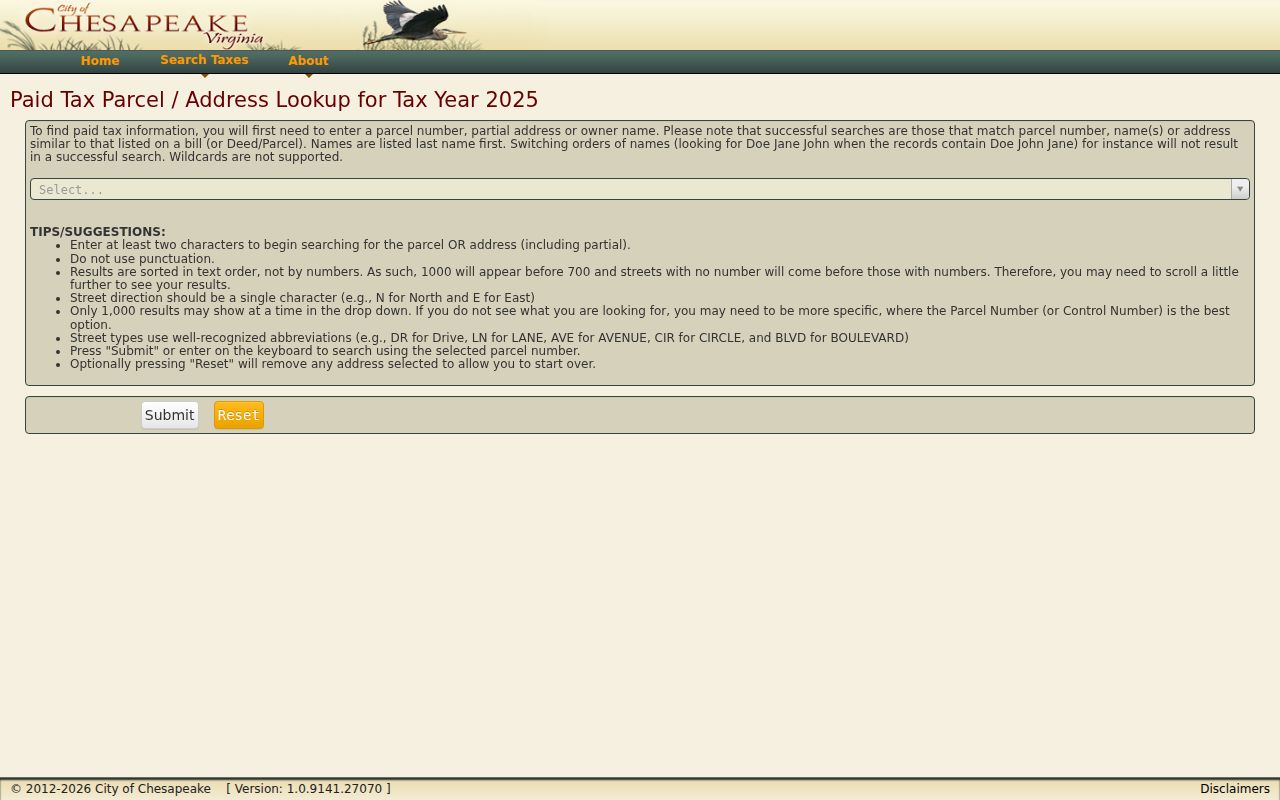
Save your search terms and the displayed tax year. A similarly named account is then far less likely to be mistaken for the parcel you meant.
- Assessed value
- The value used by the city to calculate real-estate tax.
- Tax rate
- The amount charged per $100 of assessed value.
- Paid-tax lookup
- A free search for paid bill information for the displayed year.
- Delinquent account
- An unpaid balance handled through the Treasurer's collection and court process.
A result list is not a single match. Narrow it instead of picking a similar street or owner name. The address rules still apply here. Enter two characters minimum, no punctuation, a one-letter direction, and an abbreviated street type. Owner queries still go last name first, with no wildcards. The parcel number is the strongest cross-check. It compares directly against the assessor and map result.
Paid status and outstanding status travel separate channels. The free interface supports payment-history work, but its displayed year cannot rule out an unpaid stormwater charge or a delinquent tax. Confirm payoffs with the Treasurer. A blank paid lookup is never proof of a zero balance, so name the parcel and billing period in any Treasurer request.
Appeal a Chesapeake Property Tax Assessment
Chesapeake assesses property every year. Data is gathered during the calendar year. The new assessment is dated January 1 and takes effect July 1. Notices for changed values go out in March. An owner who disputes the amount should review the parcel facts and assessment notice first, then follow the current Assessor and Board of Equalization directions rather than a prior year's calendar.
Appeal window. The published Board of Equalization filing period runs March 1 through April 1. The application is filed on paper, requires notarization, and does not accept electronic documents; confirm the current form and instructions with the city before filing.
Before contesting a number, check the property description and taxable improvements against what stands on the ground. Mistakes happen. Compare the card and the notice for parcel identity, building details, and the year the value covers. Keep the grounds tied to the assessment itself. Contact the Assessor when a record fact looks wrong. If the issue stays a valuation dispute, follow the Board's current form and filing instructions. An online paid-tax result is not an appeal submission.
Save copies as you go. Keep the notice, the assessment date, supporting property documents, and the date you submitted a review. Chesapeake's process is calendar-sensitive. It relies on paper forms with notarization, and a prior year's dates or an email to a general office mailbox should not be treated as timely unless the city expressly confirms that method.
Chesapeake Property Tax Assessment Calendar
Chesapeake keeps its own assessment clock. The value is dated January 1. It takes effect July 1. Data collection runs from January through December, and in the first week of March the city mails a changed-value notice to the owner of record. That notice gives an owner time to review the parcel and decide whether to seek a review of the new number.
New construction changes the rhythm. Additions and demolitions can trigger supplemental bills. The Treasurer sets quarterly supplemental dates of October 1, January 1, April 1, and July 1. A parcel with finished work can carry a supplemental account event apart from its ordinary annual assessment. Read the specific tax bill and the permit history. One notice rarely holds every charge.
The Real Estate Assessor's page is the city's source. It states the assessment timing and current rate, and the Chesapeake Real Estate Assessor's page shown below sets out dates, notices, and appeal information for these property tax records.
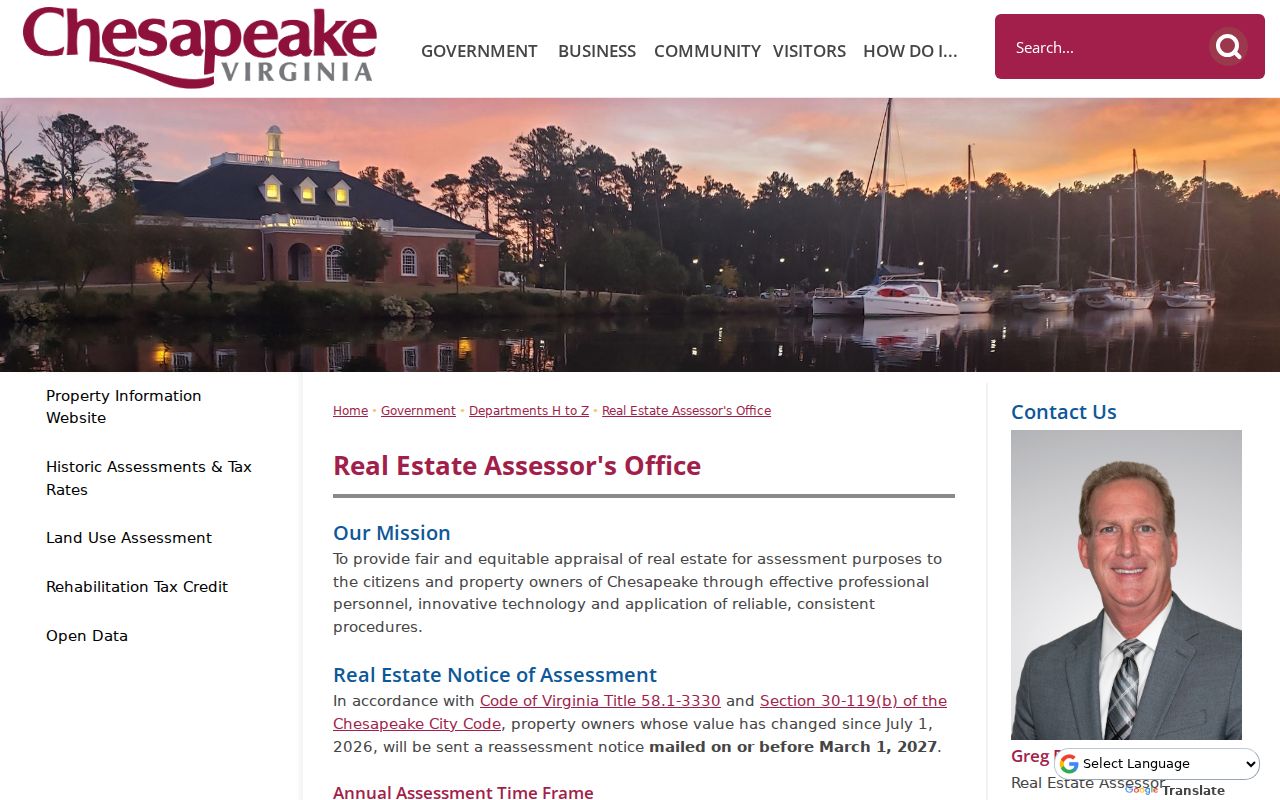
Construction creates a second calendar. The Treasurer bills supplemental charges quarterly: October 1, January 1, April 1, and July 1. New construction, additions, and demolitions all qualify. A new permit may explain a supplemental entry on the tax roll, but the permit record alone never calculates the bill.
Compare the tax statement with the permit history. Ask the Treasurer when a charge is unclear. The live notice for the parcel year still governs, since rates and instructions can change.
Paid and Outstanding Chesapeake Property Taxes
Chesapeake runs two separate tax tools. A free lookup reports paid real-estate tax information for its displayed tax year. A subscription service covers the other side: outstanding real-estate taxes and unpaid stormwater fees. Neither takes payments. The subscription product does not provide payment history either. A result in one system simply does not answer the question the other serves.
The pricing is straightforward. Annual access costs $1,100 for up to ten users, monthly access costs $100 for one user, and print searches cost $0.50 per page. Need only paid history? Start with the free lookup. A parcel with a possible delinquent balance may call for the subscription channel or a call to the Treasurer.
The outstanding tax and stormwater information page explains the paid access option and its limits, and the same Chesapeake page shown below describes the subscription product for delinquent accounts.
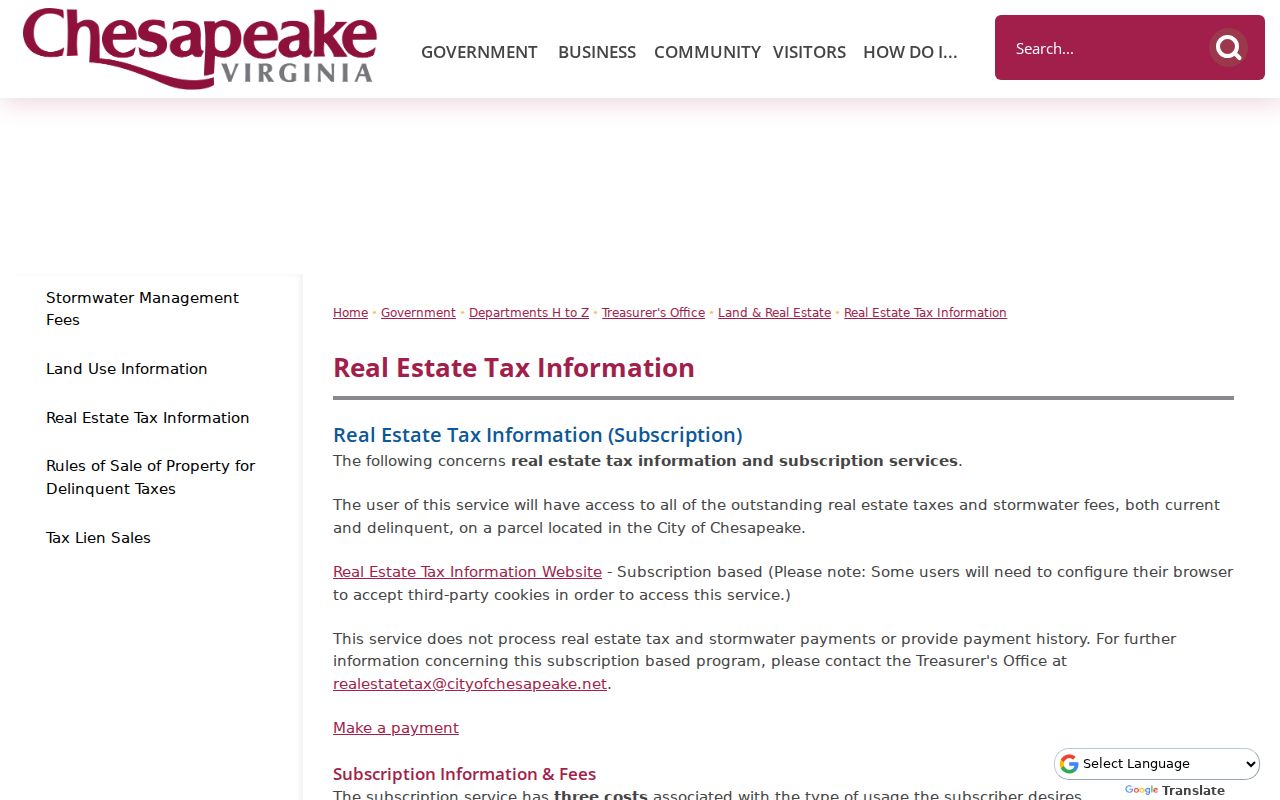
This tool is not a payment portal. It does not replace the free paid-bill search either. The subscription page prices access at $1,100 a year for up to ten users or $100 a month for one user, with printed pages at $0.50 each. The product targets delinquent real-estate taxes and unpaid stormwater fees. Paid-history questions should start with the free lookup. Neither channel shows whether a payment posted on a given day, which only the Treasurer can confirm. Before closing a property transaction, get current account confirmation straight from the office rather than treating any page image as a payoff statement. That answer is the one that counts.
Reach the Chesapeake Treasurer
Billing, payments, and delinquent collection all run through the Chesapeake Treasurer. Stormwater or tax account questions go there too. The main office sits at 306 Cedar Road. Satellite offices are listed at Deep Creek, South Norfolk, and Western Branch. Call 757-382-6281, or email paytax@cityofchesapeake.net. Main office weekday hours run 8 a.m. to 4:55 p.m.
Before you call, pull together the parcel number or bill details. Staff can then find the account fast. One quirk worth knowing: under the city's 2026 portal update, scheduled e-check payments can only be set up to 30 days ahead once September 1 arrives. Payment plans face that same 30-day limit. The Treasurer points people back to that same phone number and paytax email for help with schedules. Always confirm a current deadline from the official account rather than relying on an older notice.
Chesapeake Property Tax Bill and Payment Timing
Value and payment run on different clocks. The assessed value is dated January 1 and takes effect July 1. Supplemental charges follow their own quarterly dates. The Treasurer's 2026 portal notice said scheduled e-check payments and payment plans could be set only up to 30 days ahead beginning September 1. Settings and deadlines can change. Check the live account before arranging payment.
When you contact the office, include the parcel number, the tax year or bill date, and the exact question. The main office is at 306 Cedar Road. The phone is 757-382-6281, and email goes to paytax@cityofchesapeake.net. Ask about a current balance, a payment posting, a delinquent amount, or an unclear supplemental charge, and keep the response with the bill instead of relying on an old schedule.
Chesapeake Tax Sales and Liens
Chesapeake runs its delinquent real-estate sales through judicial proceedings under Virginia law. A delinquency entry alone proves nothing. It does not show that a foreclosure happened. Nor does it show that title changed hands. To confirm what occurred, pull the Treasurer's tax-lien notices, the Circuit Court case file, the sale terms, any court order, and the final recorded conveyance. Keep one point from the city's own page in mind: paying delinquent taxes through a tax-lien sale does not by itself transfer title.
Sale dates move fast. As an example of a dated notice, the city posted a 2026 online-only notice covering thirteen parcels, with bidding opening September 16, 2026. That notice is not a standing schedule. Before acting on any parcel lead, verify the current official notice and the case status.
For value questions, keep three figures apart. Separate the assessed amount from market evidence and from the last recorded consideration. The tax account is only one part of the property record.